When ADAS Calibration Is Necessary After Bumper and Body Repairs
Not every bumper or body repair needs ADAS calibration, and no warning light is not proof either. Learn which repairs trigger it and what records to ask for.
The need for ADAS calibration depends on the vehicle and the repair operation. A warning-free dashboard is not proof that an affected sensor remains correctly aimed. The repair plan should connect the work performed to the manufacturer’s requirements.
Is ADAS calibration necessary after every bumper or body repair?
Neither “every scratch needs calibration” nor “no warning means no calibration” is a reliable rule. Identify the system, damage and operations, then consult the applicable procedure.
Honda’s August 2025 job aid lists system-specific aiming triggers and directs technicians to model-specific service information. For applicable millimeter-wave radar systems, examples include removal and reinstallation and certain collision repairs. The same document notes that wheel alignment alone does not require camera or radar calibration unless the service information instructs it.
This distinction matters: a prerequisite for calibration is not automatically a calibration trigger in reverse. Ask the shop to explain the requirement for your actual repair rather than using a generic checklist as universal permission.
Which collision repairs can trigger calibration requirements?
Use the affected component to identify the procedure that needs checking.
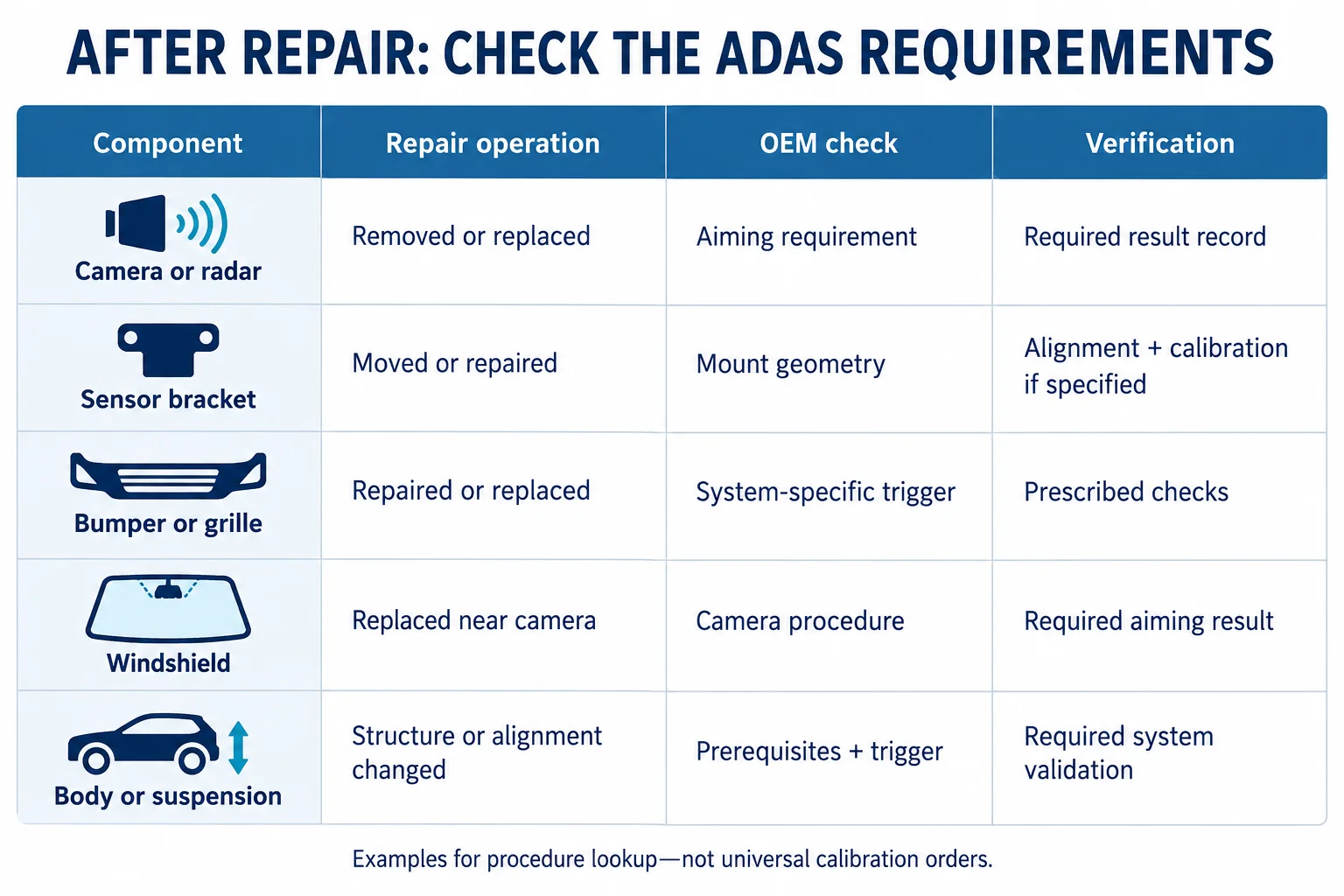
Common situations requiring a procedure review include:
- Removing or replacing a camera or radar.
- Repairing or moving its bracket or mounting panel.
- Repairing a bumper, grille or cover in a relevant sensing area.
- Structural work that changes the mounting relationship.
- Windshield work affecting a camera’s view or installation.
- Suspension or alignment operations where the exact service instructions specify additional checks.
For applicable Honda blind-spot radar systems, the job aid identifies mounting-area checks in specified replacement and body-repair circumstances. That is a system-specific example, not a rule for every rear bumper. Tell the assessor about glass work performed elsewhere as well as the body repair.
How do static and dynamic ADAS calibration differ?
I-CAR describes static and dynamic calibration as different procedures. The vehicle instructions determine whether one or both apply.
A road test is not automatically a dynamic calibration. Likewise, parking the car before targets does not prove a completed static procedure. Relevant faults, incorrect parts or displaced mounts may need correction first. The technician must follow the specified process rather than substitute a convenient method.
What should you receive to show the required checks were completed?
At handover, connect the repair to the records:
- Confirm which systems and repair triggers were assessed.
- Ask which applicable procedures were followed.
- Review relevant pre- and post-repair scan findings.
- Obtain the available calibration results identifying the vehicle and system.
- Ask about remaining faults, limitations or further work.
- Retain the documents with the final repair invoice.
A clear dashboard and a normal drive can be useful observations, but they do not replace required procedural evidence. Raise unexplained warnings or missing records with the shop before treating the work as complete.
Our general ADAS collision-repair guide explains the broader background; this checklist helps verify the trigger and completion record for your repair.
How can Pro Collision Center determine which ADAS checks your repair needs?
We can review the vehicle and repair history through a post-repair ADAS assessment and calibration.
- Provide the year, model and the original repair estimate.
- Identify bumper, structural, sensor or mounting work.
- Include information about recent glass or suspension work performed elsewhere.
- Describe any warning or change in system behavior.
- Ask us to identify the applicable checks and explain the planned documentation.
Request a free estimate from Pro Collision Center in Sacramento. Avoid testing emergency-braking functions yourself to decide whether calibration is needed.
Conclusion: How can you confirm whether your vehicle needs ADAS calibration?
Resolve the manufacturer’s requirement before closing the repair. Our recommendation is to ask for a clear chain from the affected component to the required procedure and its completion.
Sources
Whether you need collision repair, paint restoration, or just a quick quote — we’re here to help. Fill out the form and a team member will reach out promptly to confirm your appointment.